
Croatia
%20HR.png)
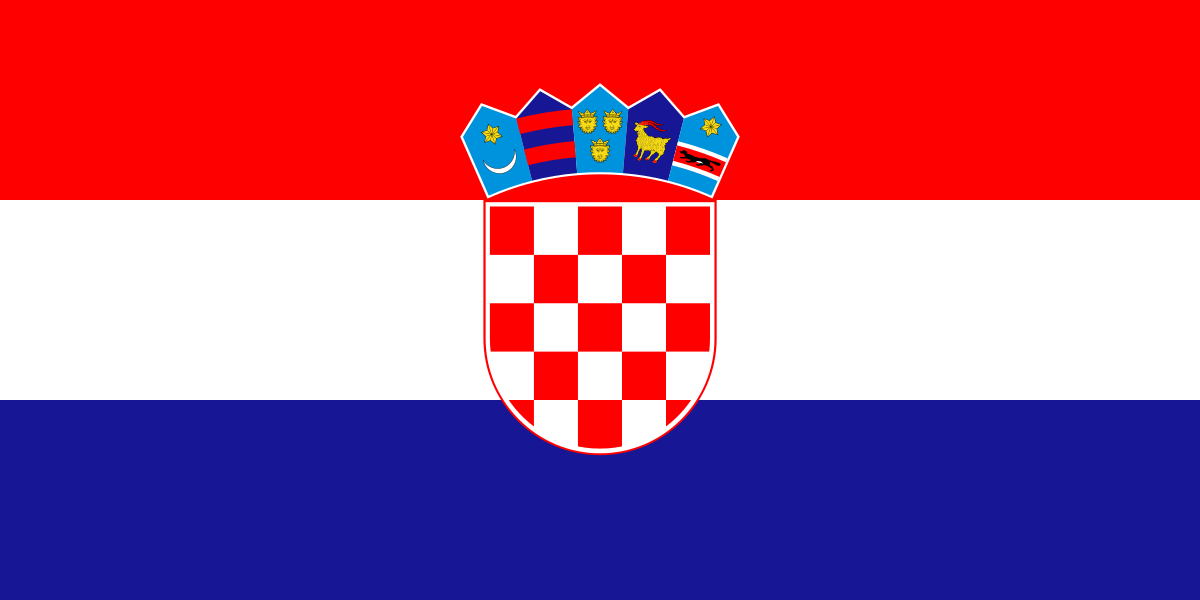
Croatia (HR)
ECRML
Signed
1997
Ratified
1997
In Force
1998
FCNM
Signed
1996
Ratified
1997
In Force
1998
Country Description
2027 will be the 180-year anniversary of Croatian as an official language in public services in Croatia. From the 13th to the mid-19th century, all Croatian parliamentary speeches and minutes had been in Latin. The first half of the 19th century saw a Croatian nationalist revival within the Austro-Hungarian Empire under the Illyrian movement: linguist, writer, and politician Ljudevit Gaj laid the foundations of Croatian-Slavonic orthography in 1830, Antun Mihanović published “Horvatska domovina” in the new spelling in 1835 (which would later become the Croatian national anthem), and Ivan Kukuljević Sakcinski held the first parliamentary speech in Croatian in 1843. At his urging, Croatian was then declared as the official language in public services by a resolution in 1847. In the 2021 national language census, more people declared themselves Croatian native speakers than Croatian nationals. For a more in-depth perspective on why, refer to Research Brief #2. The number of Croatian Sign Language users is an estimate.
Pan-National Official Language(s)
This category only includes languages that are official throughout the whole country (with the exception of Belgium) - languages that are e.g. regionally 'co-official' are not listed here but can be identified in the categories below wherever a relevant legal document is listed. A future update could include lists of co-official languages, as well.
To increase their visibility, recognised Sign Languages are always listed as official languages even if they are not yet technically official. The data on legal recognition was aggregated from legal documents and official sources. Wherever possible, the national number was taken from a national census or recent study/official estimate – sources are listed. The endangerment level is adopted from Ethnologue and further estimates of endangerment can be found on the individual language profile (e.g. by clicking on 'Italian').
| Language | Endonym | Geographic Area | Source | Legal Recognition | Legal Document | Source | National Number | Bases for Calculation | Estimation Date | Source | Endangerment Level |
|---|---|---|---|---|---|---|---|---|---|---|---|
|
Croatian
Slavic
|
Hrvatski | Whole country | 1847 (furthered in 1990) | Speech delivered in the Croatian Parliament on October 23, 1847 (Govor održan u Hrvatskom saboru 23. listopada 1847) / Constitution, Art. 12 | / / | 3 687 735 (given) | Mother Tongue | 2021 | 1 (National) | ||
|
Croatian Sign Language (HZJ)
Sign Language
|
Hrvatski znakovni jezik | Whole country | 2015 | Law on Croatian Sign Language and Other Communication Systems for Deaf and Deaf-Blind Persons in the Republic of Croatia / Zakon o hrvatskom znakovnom jeziku i ostalim sustavima komunikacije gluhih i gluhoslijepih osoba u Republici Hrvatskoj | Approx. 6 500 (not a census) | Deaf Sign Language Users | 2026 (Website accessed) | 5 (Developing) |
ECRML-Recognised Languages
This includes languages recognised under the European Charter of Regional and Minority Languages (ECRML). The data on legal recognition was aggregated from legal documents and official sources. Wherever possible, the national number was taken from a national census or recent study/official estimate – sources are listed. The endangerment level is adopted from Ethnologue and further estimates of endangerment can be found on the individual language profile (e.g. by clicking on 'Czech').
| Language | Endonym | Geographic Area | Source | Legal Recognition | Legal Document | Source | National Number | Bases for Calculation | Estimation Date | Source | Endangerment Level | ECRML level |
|---|---|---|---|---|---|---|---|---|---|---|---|---|
|
Boyash-Romanian
Indo-Aryan
|
Bayash / Rudari | Međimurje, OsijekBaranya and Sisak-Moslavina and the City of Zagreb | 1990 (furthered in 2002) | Constitution of the Republic of Croatia / The Constitutional Act on the Rights of National Minorities in the Republic of Croatia | / | 15 269 | Mother Tongue | 2021 | Not listed | Part II | ||
|
Czech
Slavic
|
Čeština | Bjelovar-Bilogora, Požega-Slavonia, Sisak-Moslavina and Zagreb counties and the City of Zagreb | 1990 (furthered in 2002) | Constitution of the Republic of Croatia / The Constitutional Act on the Rights of National Minorities in the Republic of Croatia | / | 4 915 | Mother Tongue | 2021 | 4 (Educational) | Part II & Part III | ||
|
German
Germanic
|
Deutsch | Osijek-Baranja, Zagreb and Split-Dalmatia counties | 1990 (furthered in 2002) | Constitution of the Republic of Croatia / The Constitutional Act on the Rights of National Minorities in the Republic of Croatia | / | 3 358 | Mother Tongue | 2021 | 5* (Dispersed) | Part II | ||
|
Hungarian
Uralic
|
Magyar nyelv | Osijek-Baranja, Vukovar-Syrmia, Bjelovar-Bilogora and Primorje-Gorski Kotar counties, and in the City of Zagreb | 1990 (furthered in 2002) | Constitution of the Republic of Croatia / The Constitutional Act on the Rights of National Minorities in the Republic of Croatia | / | 7 218 | Mother Tongue | 2021 | 4 (Educational) | Part II & Part III | ||
|
Istro-Romanian
Romance
|
Rumârește | Žejane, Lanišće and Šušnjevica | 1990 (furthered in 2002) | Constitution of the Republic of Croatia / The Constitutional Act on the Rights of National Minorities in the Republic of Croatia | / | 671 (for 'Romanian') | Mother Tongue | 2021 | 7 (Shifting) | Part II | ||
|
Italian
Romance
|
Italiano | Istria, Primorje-Gorski Kotar and Požega-Slavonia, and in the City of Zagreb | 1990 (furthered in 2002) | Constitution of the Republic of Croatia / The Constitutional Act on the Rights of National Minorities in the Republic of Croatia | / | 12 890 | Mother Tongue | 2021 | 2 (Provincial) | Part II & Part III | ||
|
Rusyn / Ruthenian
Slavic
|
Rusîn'skyj jazyk | Vukovar-Syrmia and Osijek-Baranya and in the City of Zagreb | 1990 (furthered in 2002) | Constitution of the Republic of Croatia / The Constitutional Act on the Rights of National Minorities in the Republic of Croatia | / | 1 011 | Mother Tongue | 2021 | 6a* (Vigorous) | Part II & Part III | ||
|
Serbian
Slavic
|
Srpski | Cities of Vukovar and Vrbovsko, and municipalities Krnjak, Vojnić, Donji Lapac, Vrhovine, Udbina, Šodolovci, Jagodnjak, Erdut, Dvor, Gvozd, Donji Kukuruzari, Biskupija, Civljane, Kistanje, Ervenik, Markušica, Trpinja, Negoslavci, Borovo, Gračac and Plašk | 1990 (furthered in 2002) | Constitution of the Republic of Croatia / The Constitutional Act on the Rights of National Minorities in the Republic of Croatia | / | 49 282 | Mother Tongue | 2021 | 4 (Educational) | Part II & Part III | ||
|
Slovak
Slavic
|
Slovenský jazyk | Osijek-Baranya County, Vukovar-Syrmia County and the City of Zagreb | 1990 (furthered in 2002) | Constitution of the Republic of Croatia / The Constitutional Act on the Rights of National Minorities in the Republic of Croatia | / | 2 859 | Mother Tongue | 2021 | 5* (Dispersed) | Part II & Part III | ||
|
Slovenian
Slavic
|
Slovenski jezik | City of Zagreb and the counties of Primorje-Gorski Kotar, Split-Dalmatia, Zagreb, Varaždin and Osijek-Baranya | 1990 (furthered in 2002) | Constitution of the Republic of Croatia / The Constitutional Act on the Rights of National Minorities in the Republic of Croatia | / | 7 620 | Mother Tongue | 2021 | 5* (Dispersed) | Part II | ||
|
Ukrainian
Slavic
|
Ukrainska mova | Vukovar-Syrmia County, City of Zagreb, counties of SisakMoslavina, Brod-Posavina, Primorje-Gorski Kotar, Istria, Zagreb and Split-Dalmatia | 1990 (furthered in 2002) | Constitution of the Republic of Croatia / The Constitutional Act on the Rights of National Minorities in the Republic of Croatia | / | 1 198 | Mother Tongue | 2021 | 5* (Dispersed) | Part II & Part III |
Non-ECRML Languages – Source Overview
Languages marked with ✓ appear in that source.
Languages listed in multiple sources may have differing data – see the detail tables below.
| Language | Ethnologue | ELP |
|---|---|---|
| Balkan Romani | ✓ | |
| Baltic Romani | ✓ | |
| Bosnian | ✓ | |
| Carpathian Romani | ✓ | |
| Chakavian | ✓ | |
| Dalmatian | ✓ | |
| English | ✓ | |
| French | ✓ | |
| Istriot | ✓ | ✓ |
| Sinte Romani | ✓ | |
| Venetian | ✓ | |
| Vlax Romani | ✓ |
Non-ECRML Languages (Ethnologue)
Languages listed with an 'established status' in Ethnologue. The data on legal recognition, national number, and endangerment level was taken from Ethnologue, reflecting its current state and gaps of knowledge.
| Language | Endonym | Geographic Area | Source | Legal Recognition | Legal Document | Source | National Number | Bases for Calculation | Estimation Date | Source | Endangerment Level |
|---|---|---|---|---|---|---|---|---|---|---|---|
|
Bosnian
Slavic
|
Bosanski | Dubrovnik-Neretva, Istria, Primorje-Gorski Kotar, Sisak-Moslavina, Split-Dalmatia, Vukovar-Syrmia, and Zagreb city | 2002 | Constitutional Law on the Rights of Minorities, Article 15 | / | 17 500 | Users | 2021 | 5* (Dispersed) | ||
|
Chakavian
Slavic
|
Čakavski | Istria county; Primorje-Gorski Kotar and Split-Dalmatia counties: coastal area and islands | / | / | / | 50 000 | Users | 2019 | 6b (Threatened) | ||
|
Dalmatian
Romance
|
Dalmato | Dubrovnik-Neretva, Šibenik-Knin, Split-Dalmatia, and Zadar counties | / | / | / | No known L1 speakers | / | / | 10 (Extinct) | ||
|
English
Germanic
|
English | / | / | / | / | 2 002 860 | Users | 2021 | 4 (Educational) | ||
|
French
Romance
|
Français | / | / | / | / | 96 460 | Users | 2021 | 5* (Dispersed) | ||
|
Istriot
Romance
|
Eîstrioto | Istria county: Bale, Fažana, Galižana, Rovinj, Šišan, and Vodnjan towns. Istrian peninsula, west coast | / | / | / | 1 300 | Users | 2007 | 6b (Threatened) | ||
|
Venetian
Romance
|
Vèneto | Istria and Split-Dalmatia counties: most of Istria peninsula, Fiume-Rijeka city, some cities in Kvarner and coastal Dalmatia | / | / | / | 50 000 | Users | 1994 | 5* (Developing) |
Non-ECRML Languages (Endangered Languages Project)
Languages listed in the Endangered Languages Project (ELP). The data on legal recognition, national number, and endangerment level was taken from ELP, reflecting its current state and gaps of knowledge.
| Language | Endonym | Geographic Area | Source | Legal Recognition | Legal Document | Source | National Number | Bases for Calculation | Estimation Date | Source | Endangerment Level |
|---|---|---|---|---|---|---|---|---|---|---|---|
|
Balkan Romani
Indo-Aryan
|
Balkaniko Romanes | / | / | / | / | 709 570 (international) | Speakers | 2026 (Website accessed) | At risk | ||
|
Baltic Romani
Indo-Aryan
|
Roma | / | / | / | / | 58 460 (international) | Speakers | 2026 (Website accessed) | Vulnerable | ||
|
Carpathian Romani
Indo-Aryan
|
Central Romani | / | / | / | / | 472 470 (international) | Speakers | 2026 (Website accessed) | At risk | ||
|
Istriot
Romance
|
Eîstrioto | / | / | / | / | 1 000 (international) | Speakers | 2027 (Website accessed) | / | ||
|
Sinte Romani
Indo-Aryan
|
Romanes | / | / | / | / | 318 920 (international) | Speakers | 2026 (Website accessed) | At risk | ||
|
Vlax Romani
Indo-Aryan
|
Romani shib | / | / | / | / | 885 970 (international) | Speakers | 2026 (Website accessed) | At risk |
Recognised Minorities
Add a comment